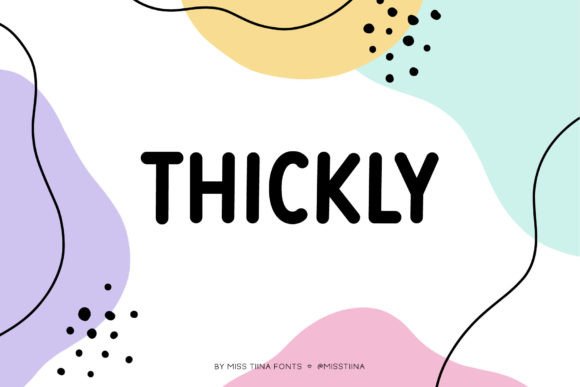
Thickly Font Review: A Friendly Handwritten Sans Serif
There is a specific moment in every boutique branding project where the mood board looks perfect, but the typography feels too stiff. I recently experienced this while refreshing the visual identity for a local artisanal bakery. The client wanted warmth and approachability, but standard geometric sans serifs felt cold, and traditional scripts were too ornate for their modern packaging. That was when I decided to test Thickly, a handwritten sans serif font that promised to bridge the gap between casual charm and structural clarity.
Opening the file, my first impression was that Thickly manages to be cute without being childish. In the world of display fonts, this is a difficult balance to strike. Many handwritten typefaces sacrifice legibility for style, or they lean so heavily into whimsy that they become unusable for serious brand identity work. After spending a week testing Thickly across logo concepts, packaging mockups, and digital layouts, I found it to be a surprisingly versatile tool for designers who need personality without sacrificing professional polish.
Visual Character and Brand Personality
Thickly is defined by its soft, rounded terminals and consistent stroke width. Unlike brush scripts that vary wildly in weight, this typeface maintains a steady rhythm that makes it feel grounded. The "handwritten" aspect comes from the slight organic imperfections in the curves rather than chaotic flourishes. This gives it a human touch that feels authentic, like a note written by a friend rather than a computer-generated simulation.
In my bakery project, this visual character immediately solved the tone problem. When placed next to high-resolution photography of sourdough and pastries, Thickly didn't compete with the imagery; it complemented it. The font carries an inherent friendliness that works exceptionally well for lifestyle brands, children’s products, creative studios, and hospitality businesses. It signals to the audience that the brand is accessible and personal. However, because it retains the skeleton of a sans serif, it avoids looking like a novelty font. It has enough structural integrity to serve as a primary logotype or a dominant headline element in a brand system.
Performance Across Design Assets
A pretty font is useless if it falls apart in production. I tested Thickly in several realistic scenarios to see how it holds up outside of the design software preview window.
- Logo Design: Thickly shines as a wordmark for small businesses. The letterforms are distinct enough to be recognizable at smaller sizes, though I would recommend tightening the tracking slightly for logo use to create a more cohesive unit. It lacks built-in ligatures, so manual kerning adjustments are necessary to avoid awkward gaps between specific letter pairs.
- Packaging and Labels: This is arguably where Thickly performs best. On a product label or jar sticker, the bold, rounded strokes remain legible even when printed on textured paper or kraft stock. It has enough visual weight to stand out against busy backgrounds without requiring excessive drop shadows or outlines.
- Social Media Graphics: For Instagram carousels and Pinterest pins, Thickly acts as an excellent hook. It stops the scroll because it feels native to social platforms where authentic, user-generated content thrives. I used it for quote overlays and announcement headers, and it maintained clarity even on mobile screens.
- Web Headers: As a web font, Thickly works beautifully for H1 and H2 tags in hero sections. However, I would advise against using it for navigation menus or body text. Its personality is strong, and overusing it on a website can lead to visual fatigue and accessibility issues.
Pairing Strategies and Hierarchy
Because Thickly is a display font with such a distinct voice, it needs a supportive partner. During the branding project, I found that pairing it with another handwritten font created too much noise. Instead, the most successful combinations involved contrast.
For the bakery identity, I paired Thickly with a clean, neutral neo-grotesque sans serif for body copy and ingredient lists. The sharpness of the supporting font made Thickly’s roundness pop, establishing a clear visual hierarchy. Alternatively, a classic serif font can add a layer of sophistication if you want to elevate the brand perception. For example, using Thickly for the brand name and a refined editorial serif for taglines creates a "modern heritage" aesthetic that feels both established and fresh.
When building a brand board, treat Thickly as your accent or headline typeface. Use it for short phrases, calls to action, and emotional touchpoints. Let your secondary typeface handle the heavy lifting of information delivery. This restraint ensures that when Thickly does appear, it retains its impact and charm.
Practical Limitations and Licensing
No font is perfect for every job, and honesty about limitations is crucial for professional results. Thickly is not suitable for long-form text, legal disclaimers, or dense data tables. The rounded forms and open counters that make it friendly also reduce its space efficiency and reading speed at small sizes. If your project requires extensive body copy, technical documentation, or a formal corporate tone, look elsewhere. This is a typeface for connection, not instruction manuals.
Additionally, always verify the licensing before finalizing client work. While Thickly is excellent for crafts, greeting cards, and personal projects, commercial use for brand identities, merchandise, or digital products often requires a specific license tier. Check whether the license covers webfont embedding, app usage, or print-on-demand products if those are part of your deliverables. Securing the correct commercial font license protects both you and your client from future legal complications.
Integrating Thickly Into Your Workflow
If you are considering adding Thickly to your typography toolkit, start by testing it in low-stakes environments. Create a few mock social media posts or draft business cards to see how the spacing feels in context. Pay attention to how it interacts with color; softer, muted palettes tend to enhance its friendly nature, while high-contrast neon combinations can push it toward a more playful, retro vibe.
Ultimately, Thickly earns its place as a favorite not because it is trendy, but because it solves a genuine design problem. It provides the warmth of handwriting with the reliability of a sans serif structure. For designers working on brands that need to feel human, approachable, and genuinely crafted, this typeface offers a reliable foundation. Just remember to let it breathe, pair it wisely, and reserve it for moments where personality matters most.